
ISO 9001:2026 Is Here: What Has Changed and How AI-Assisted Compliance Automation Is Transforming Quality Management
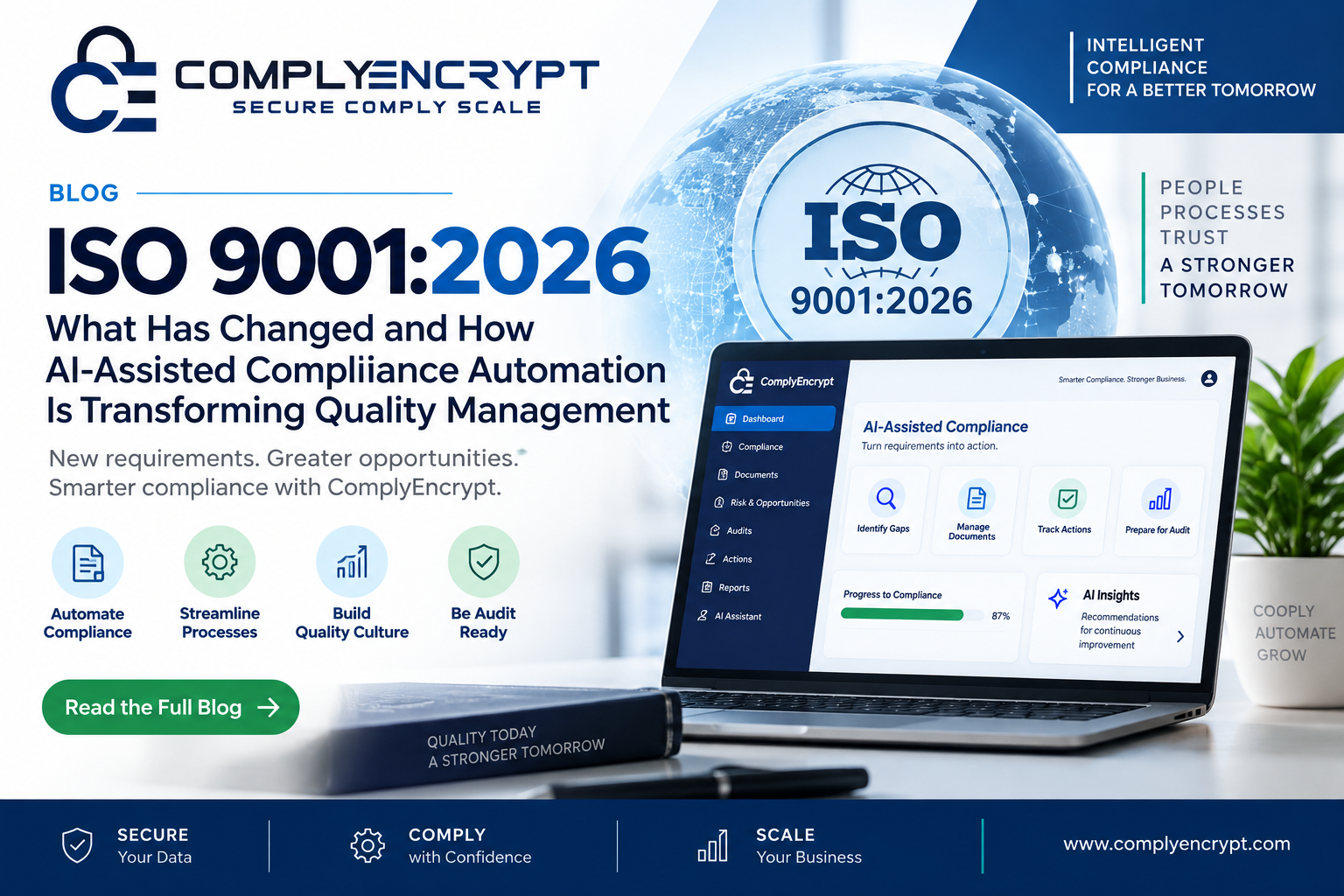
ComplyEncrypt is building the infrastructure for the next generation of quality management.
The world of quality management is entering a new chapter. With the publication of ISO 9001:2026 on 16 September 2026, organizations have a renewed opportunity to strengthen their quality management systems, improve operational visibility, and embrace more intelligent ways of managing compliance.
At ComplyEncrypt, we are excited to announce our commitment to supporting this transformation through infrastructure for ISO 9001:2026 AI-assisted compliance automation.
Our vision is to help organizations move beyond manual compliance administration toward connected, intelligent, and continuously improving quality management workflows.
What is ISO 9001:2026?
ISO 9001:2026 is the latest edition of the internationally recognized standard for quality management systems (QMS). It builds on the foundation of ISO 9001:2015 and introduces updates intended to reflect the evolving needs of modern organizations.
The revised standard places greater emphasis on quality culture, ethical behaviour, climate-related considerations, and clearer approaches to risks and opportunities. It also retains the core process-based management system approach that organizations worldwide already use.
For organizations certified to ISO 9001:2015, the transition is an opportunity to review existing processes, strengthen implementation, and ensure that quality management remains aligned with business objectives.
Key changes in ISO 9001:2026
1. Greater emphasis on quality culture and ethical behaviour
Quality management is not only about procedures, records, and audits. It is also about how people make decisions and how leadership establishes expectations throughout the organization.
ISO 9001:2026 gives greater prominence to quality culture and ethical behaviour. Organizations should consider how leadership, employee awareness, and everyday decisions support the achievement of quality objectives.
What this means in practice:
- Strengthening leadership communication about quality.
- Promoting ethical decision-making.
- Ensuring employees understand their contribution to the QMS.
- Integrating quality expectations into organizational activities.
- Evaluating whether quality culture supports continual improvement.
A quality management system becomes more effective when quality is embedded in the way an organization operates—not simply maintained as a certification requirement.
2. Climate change considerations in the QMS
Climate change considerations introduced through the 2024 ISO management system amendments are now incorporated into the revised standard.
Organizations need to determine whether climate change is a relevant issue affecting their ability to achieve intended QMS results. They must also consider relevant interested-party requirements.
Potential considerations include:
- Disruptions to supply chains.
- Extreme weather affecting operations.
- Availability of infrastructure and resources.
- Customer or regulatory expectations.
- Climate-related risks affecting product and service delivery.
This does not mean every organization must implement an environmental management system. The focus is on understanding and addressing climate-related issues where they are relevant to the quality management system.
3. Clearer treatment of risks and opportunities
Risk-based thinking remains a central part of ISO 9001. The 2026 revision provides greater clarity around the treatment of risks and opportunities.
Organizations should be able to demonstrate how they identify relevant risks, evaluate their significance, determine appropriate actions, and monitor outcomes.
Opportunities should also receive meaningful consideration rather than being treated as an afterthought.
For example, an organization may identify an opportunity to:
- Improve production efficiency.
- Introduce automated quality inspections.
- Reduce recurring customer complaints.
- Strengthen supplier performance.
- Improve employee competence.
The objective is to connect risk and opportunity management with actual business decisions and QMS performance.
4. Stronger connection between quality and organizational strategy
A QMS should support the organization's strategic direction.
ISO 9001:2026 reinforces the importance of ensuring that quality objectives, processes, resources, and performance evaluation contribute to organizational goals.
This encourages organizations to ask:
Are our quality objectives aligned with what the business is trying to achieve?
A more integrated approach can help management understand how quality performance influences customer satisfaction, operational efficiency, compliance, and long-term business sustainability.
5. More structured management of QMS changes
Organizations continually change their processes, technology, people, suppliers, and operating environments.
The revised standard provides clearer expectations for planning and managing changes to the QMS.
Organizations should consider the purpose and potential consequences of changes, resource availability, responsibilities, communication, and the integrity of the management system.
A well-managed change process helps ensure that improvements do not unintentionally create new quality risks.
6. Greater value from organizational knowledge
Knowledge is an important organizational resource.
Organizations need to identify, maintain, and apply the knowledge required to operate their processes and achieve conformity of products and services.
In practical terms, this may include:
- Retaining lessons learned from nonconformities.
- Maintaining process-specific expertise.
- Sharing knowledge across teams.
- Capturing knowledge when experienced employees leave.
- Using documented information and training to support consistent performance.
Digital knowledge management and AI-assisted systems can help organizations make relevant information easier to access and apply.
7. Expanded guidance through Annex A
ISO 9001:2026 includes an enhanced Annex A to support the interpretation and application of the standard.
Annex A provides guidance and clarification; it does not create additional auditable requirements.
Organizations can use this guidance to better understand the intent of the requirements and improve consistency in implementation.
What remains familiar?
The revised standard does not abandon the established QMS framework.
Organizations will continue to work with the familiar management system areas covering:
- Context of the organization.
- Leadership.
- Planning.
- Support.
- Operation.
- Performance evaluation.
- Improvement.
Core activities such as internal audits, management reviews, corrective action, documented information, supplier controls, and continual improvement remain important parts of an effective QMS.
For many organizations, ISO 9001:2026 represents an evolution of the existing system rather than a complete rebuild.
The exciting news: ComplyEncrypt is building infrastructure for ISO 9001:2026 AI-assisted compliance automation
Traditional compliance management can involve extensive manual work: maintaining documents, tracking corrective actions, preparing audit evidence, reviewing requirements, and coordinating activities across departments.
As organizations prepare for ISO 9001:2026, there is an opportunity to make these activities more connected and intelligent.
ComplyEncrypt is providing the infrastructure for ISO 9001:2026 AI-assisted compliance automation.
Our goal is to support organizations with a technology foundation that can help connect quality requirements, organizational processes, documented information, compliance activities, and improvement workflows.
AI-assisted compliance automation has the potential to help organizations:
Understand requirements more efficiently
AI can assist users in reviewing applicable requirements, identifying relevant organizational processes, and understanding where further assessment may be needed.
Support gap analysis
Organizations can use intelligent workflows to help identify potential gaps between their current QMS and applicable requirements.
AI-generated findings should be reviewed and validated by qualified personnel before being treated as formal compliance conclusions.
Improve document and knowledge management
A connected compliance infrastructure can help organizations organize policies, procedures, records, and supporting evidence.
AI assistance can help users locate relevant information, identify potential inconsistencies, and support the maintenance of controlled documented information.
Strengthen corrective action management
AI-assisted workflows can help track nonconformities, support root-cause analysis, monitor action owners and deadlines, and organize evidence of completed actions.
Human review remains essential to confirm the adequacy and effectiveness of corrective actions.
Support internal audit preparation
AI can assist in organizing audit programs, preparing questions, identifying relevant documented information, and summarizing findings for review.
The auditor remains responsible for professional judgment, objective evidence, and audit conclusions.
Enable continuous compliance visibility
Rather than waiting until an audit approaches, organizations can work toward more continuous visibility of QMS activities, outstanding actions, document status, and performance indicators.
This supports a proactive approach to quality management.
Why AI-assisted compliance automation matters for ISO 9001:2026
The revised standard places continued emphasis on effective processes, leadership, risks and opportunities, organizational knowledge, and improvement.
These areas generate information that organizations must manage and use.
AI-assisted automation can help transform that information into more accessible workflows and decision-support tools.
For example:
Quality requirement → Organizational process → Evidence → Review → Improvement
A connected infrastructure can support this flow by helping users organize relevant information and coordinate compliance activities.
However, automation should support—not replace—management responsibility, competent personnel, professional judgment, and the independent role of certification bodies.
Preparing your organization for ISO 9001:2026
Organizations certified to ISO 9001:2015 should begin by understanding the revised requirements and evaluating their existing QMS.
A practical preparation approach includes:
1. Understand the revision: Review the published ISO 9001:2026 requirements and applicable transition guidance.
2. Conduct a gap assessment: Identify areas requiring updates in the QMS.
3. Review leadership and quality culture: Evaluate how quality expectations are communicated and implemented.
4. Reassess context and interested parties: Consider relevant climate-related issues and other changes.
5. Review risks and opportunities: Ensure that both are addressed appropriately.
6. Evaluate QMS changes: Check whether changes are planned, controlled, and effective.
7. Strengthen organizational knowledge: Improve the availability and retention of relevant knowledge.
8. Explore AI-assisted workflows: Identify repetitive compliance activities that could benefit from intelligent support.
9. Plan the transition: Coordinate with your certification body regarding the applicable transition arrangements.
Existing ISO 9001:2015 certificates remain valid during the transition period, subject to applicable certification and accreditation arrangements. TÜV SÜD reports a 36-month transition period following publication. Organizations should confirm the specific requirements and timetable with their certification body.
ComplyEncrypt: Building the future of intelligent compliance
ISO 9001:2026 presents an opportunity to rethink how organizations manage quality.
The future of compliance is not simply about producing more documents or completing more checklists. It is about making quality information accessible, connecting requirements with organizational activities, supporting informed decisions, and enabling continual improvement.
ComplyEncrypt is working to provide the infrastructure for this future through AI-assisted compliance automation for ISO 9001:2026.
Our vision is to help organizations build more connected, transparent, and intelligent compliance workflows—supporting quality professionals and management teams as they navigate the evolving requirements of modern quality management.
The next generation of quality management is being built on intelligent infrastructure. ComplyEncrypt is excited to be part of that journey.
Discover the future of compliance automation
Learn more about ComplyEncrypt and our vision for AI-assisted compliance automation.
Visit: ComplyEncrypt
Disclaimer: This article provides general information about ISO 9001:2026 and AI-assisted compliance automation. Organizations should consult the published standard, applicable transition guidance, and their certification body for authoritative requirements and transition arrangements. AI-assisted tools do not replace management responsibility, competent personnel, internal audit judgment, or certification-body assessment.
Sources
- ISO 9001:2026 publication and revision information: ISO
- ISO 9001:2026 transition information: TÜV SÜD
- ISO 9001:2026 publication announcement: TÜV SÜD / Business Wire